Reflections from the AI4LAM Conference – Staff Perspective
At the Fantastic Futures conference, Georgia State University Library’s Kevin Bond, Digitization Lab Supervisor, learned how libraries, archives, and museums are experimenting with artificial intelligence. In this reflection, he shares examples from the conference and considers what they mean for his work with digital collections at Georgia State.
By Kevin Bond, GSU Library Digitization Lab Supervisor
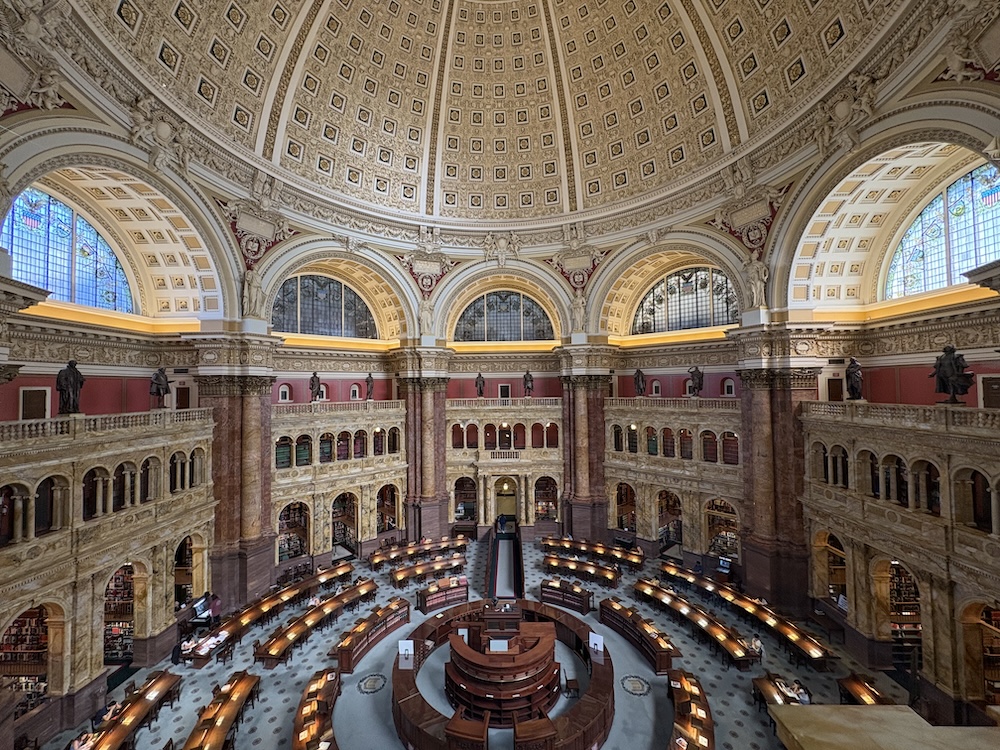
I wasn’t entirely sure what to expect going in, but attending the Artificial Intelligence for Libraries, Archives & Museums (AI4LAM) Fantastic Futures conference at the Library of Congress turned out to be an incredible eye-opening deep dive into the real-world future of AI in libraries, archives, and museums. Co-hosted alongside the Smithsonian Institution and the National Gallery of Art, this international conference serves as one of the largest global gatherings that focuses on artificial intelligence and cultural heritage.
The organization AI4LAM has its roots in Norway which helped bring a diverse international group of professionals to the event, and the vibe all week was a fascinating mix of excitement and reality-checking. Everyone there, from archivists and librarians to software developers, was wrestling with the exact same puzzle: How do libraries, archives, and museums shape the future of AI rather than just react to it?
There was so much covered over those three days that my notebook was practically overflowing. Since I can’t fit three full days of AI research into one post, I’ll highlight a few key discussions that really resonated with me, starting with a talk by Betts Coup of Harvard University Library.
Coup addressed the tension folks in digital library services have been feeling, which is the pressure to adopt generative AI for operational efficiency versus our commitment to the core values of archival practice. Grounded in her own real-world experimentation at a large-scale academic archive, Coup outlined four foundational principles that I found fascinating.
- Access: Ensuring AI enhances public reach without distorting context.
- Labor: Mitigating repetitive workloads without devaluing human expertise.
- Transparency: Remaining explicit about where and how AI models are applied.
- Archival Judgment: Preserving the indispensable role of human discernment.
Overall, she was emphasizing that AI can accelerate descriptive workflows, but it cannot replace human care. These tools are not neutral, and they carry environmental, ethical, and material costs. As information professionals, we must take an active, critical role in shaping how these tools are integrated rather than passively adopting commercial solutions.
Another highlight for me was a panel with folks from HathiTrust, Authors Alliance, and University of Nebraska–Lincoln (UNL) that got into the real politics of AI data. Right now, Big Tech dominates the large language model (LLM) landscape, but the web-scraped data they rely on is full of noise and bias. Digitized library books, on the other hand, are rich, curated, and reliable. The panelists argued that libraries need to step up, rather than just subscribing to black-box commercial tools. We should be using frameworks like fair use to curate public-interest datasets that benefit everyone, ensuring AI research serves the public good rather than just corporate bottom lines.
In addition to these large-scale policy debates, the conference was filled with a wide variety of new, forward-thinking approaches for practical AI applications. The Music Archive of Finland’s Juha Henriksson told attendees to move beyond simple chatbots and start preparing for what he calls “Agentic AI,” autonomous agents that will soon be accessing libraries’ API directly. From the researcher side, Joseph Hartnett of Baruch College has developed an open-source tool to enable researchers to save their AI generated conversation logs as they work through research, ensuring their intellectual process isn’t trapped inside a corporate platform’s silo.
For those of us working closely with digital collections, projects like CultuR-AI and recent initiatives at National Archives and Records Administration (NARA) were especially encouraging. They demonstrated how generative AI can clean up messy historical OCR, automate record linking, and boost searchability without getting rid of human oversight. There was also many teams working to use AI to identify relationships across time and space. For example, Princeton researchers presented on refining models to account for the time gap between sequential archives, while a University of Chicago team has been using Natural Language Embeddings to virtually reunite Chinese artifacts from different museums around the world. The Diriyah Biennale Foundation is training computer vision models using International Image Interoperability Framework (IIIF) on Islamic art and geometry patterns to avoid potential Western biases in computer vision.
Coming back to GSU, the main thing I took away from all of this is the sentiment that keeping humans involved is not some transitional step toward automation, it is the fundamental idea. Our goals should never be to create automated assembly lines in place of human intelligence, but rather to develop transparent, trustworthy systems that allow our staff and students to interact with information in more meaningful and impactful ways.
For more info about AI4LAM or the resources they have made available check out the links below
- Conference website: https://ai4lam.org/
- A curated list of resources, projects, and tools for using Artificial Intelligence in Libraries, Archives, and Museums: https://ai4lam.github.io/awesome-ai4lam/
- AI4LAM Youtube channel: https://www.youtube.com/@ai4lam120