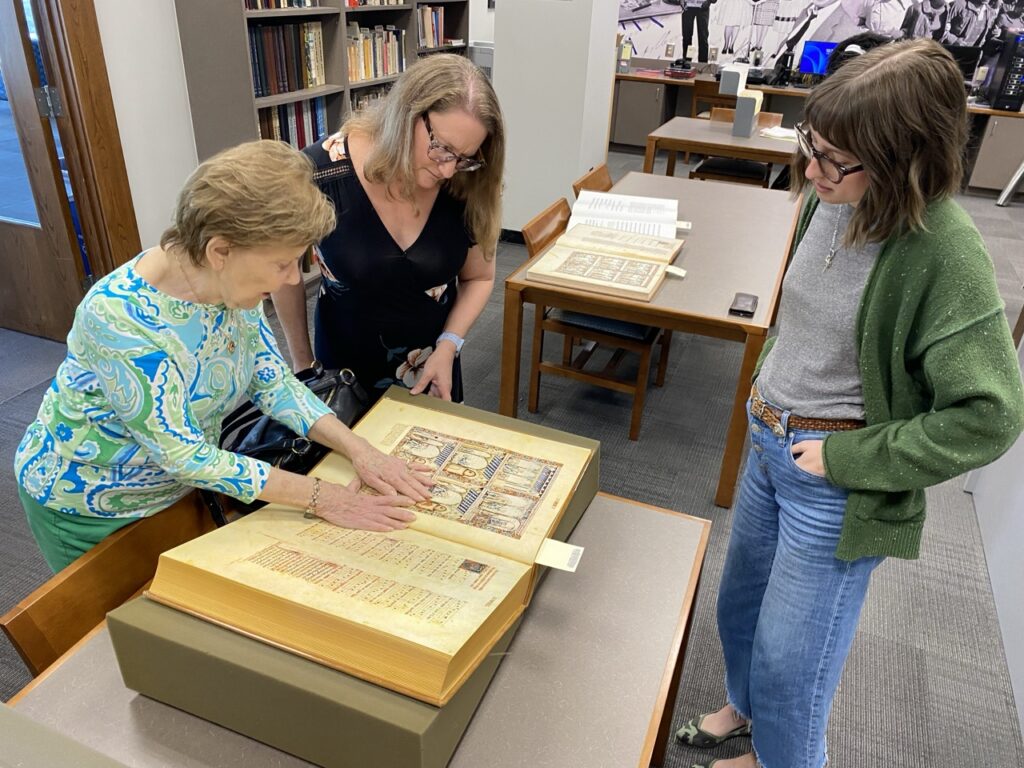
Our Latest Rare Book Addition: Cantigas de Santa María
by Christina Zamon
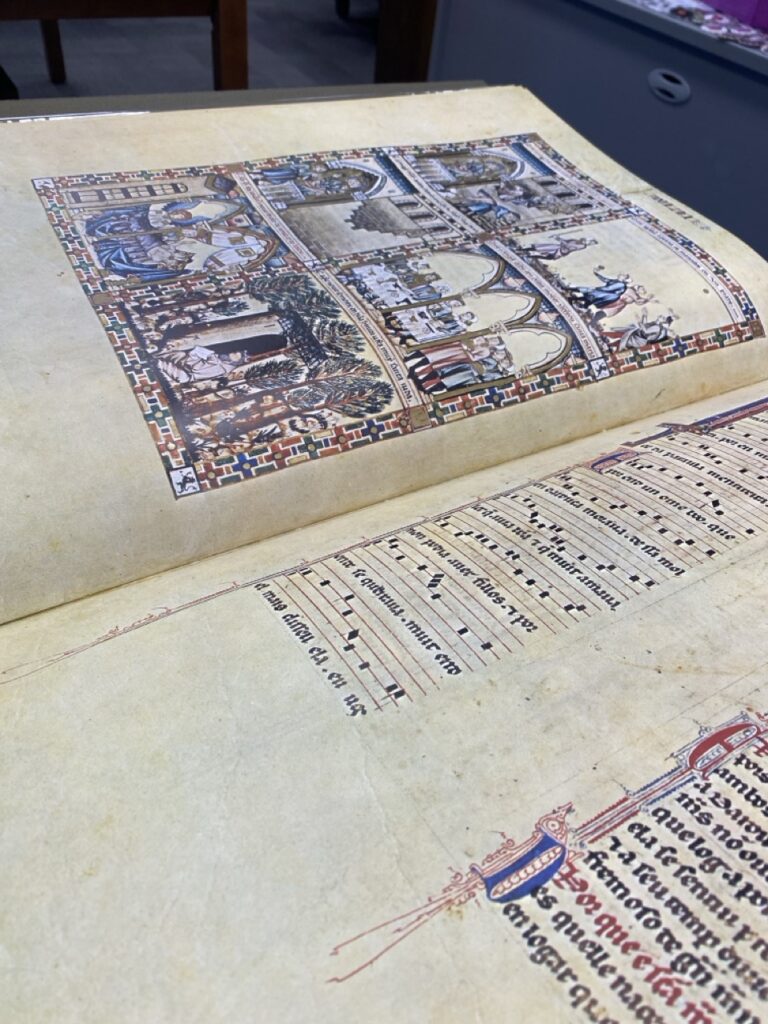
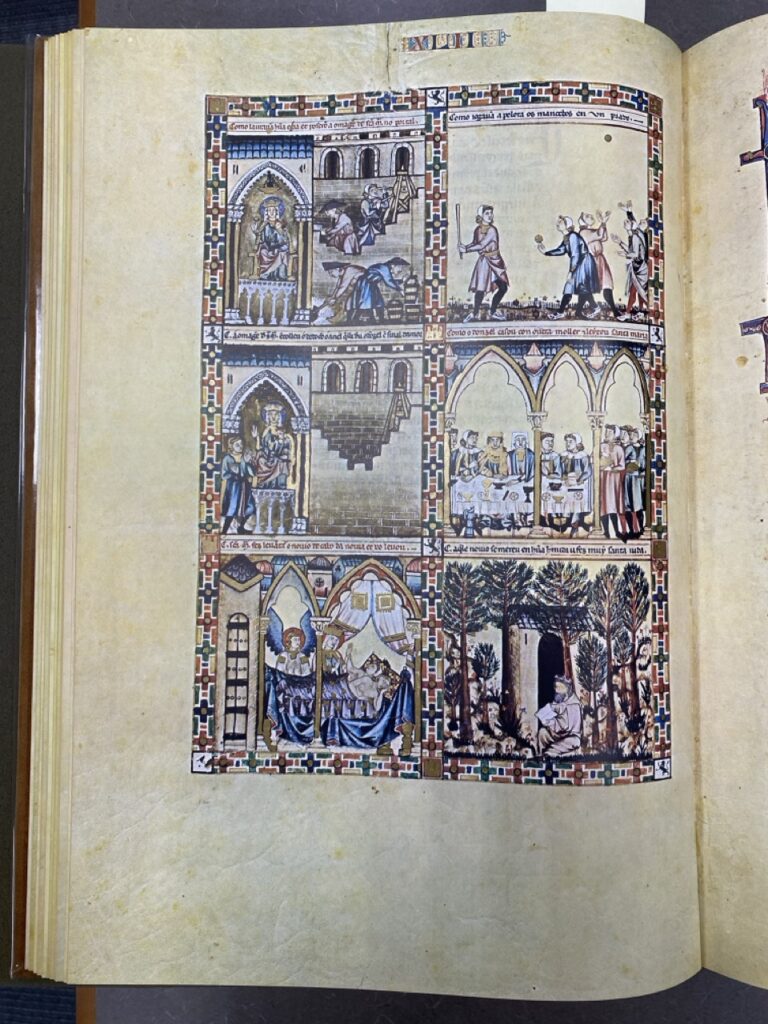
Longtime faculty member Dr. Annette Grant Cash has been a lover of the Cantigas de Santa María since her days as a student. She became so fascinated by it she continued to study the books and wrote her own book about it, Daily Life Depicted in the Cantigas de Santa María, along with her former professor, Dr. John Esten Keller III in 1998.
According to her book’s introduction,
“The Cantigas de Santa María is a book about miracles and a miraculous book. Inspired by King Alfonso’s devotion to the Virgin Mary, it extols her virtues through art, music, and poetry, which convey a rich composite of the life, culture, and thought of thirteenth-century Iberia.
- Daily Life Depicted in the Cantigas de Santa María, p. ix
Dr. Cash was also instrumental in facilitating the library’s acquisition of the Cantigas de Santa Maria, Edilán facsimile edition printed in 1979 from Victor Soler-Sala. She was gifted her edition of the Cantigas de Santa María after her professor, Dr. Keller, passed away in 2010.
Alfonso X, el Sabio (Alfonso the Tenth, known as the Wise) ruled Spain from 1252-1284. He was called the Wise because of his interest in all things. He wrote a book about chess and how to play the game and about the heavenly spheres. He had many Hebrew and Arabic works translated into Spanish, wrote a law treatise called Las siete partidas dividing the law into seven parts. The 13th century is the time of Mariology broadly defined as the study of devotion to and thinking about Mary as the compassionate and forgiving mother and miracle worker. His contribution is Las cantigas de Santa Maria.
Within the Cantigas de Santa María there are 420 songs which speak to the miracles she performed as well as hymns of praise to her. The Escorial manuscript observes a schemata of every fifth cantiga given two pages of illustrations (12 illuminations) and every tenth cantiga as a song of praise to the Virgin. (15, 25, 35, 45, etc. 10, 20, 30). The Florentine manuscript does not observe this structure. Several pages of illuminations are incomplete, not having the caption underneath each frame, reflecting the story being told or the praise being given. The incompleteness tells us how the miniaturist worked, and we see that faces and hands were often the last things drawn and then the scribe wrote the caption.
Dr. Cash also translated the marginalia of the first 25 cantigas of the Escorial manuscript into English with commentary with Dr. James C. Murray.
The GSU Library’s Special Collections and Archives is honored to add these important volumes into its rare book collection, complementing our holdings of our other facsimile folios of the Cantigas. For further information about the Cantigas de Santa María see the Centre for the Study of the Cantigas de Santa María of Oxford University.